


The most common causes of lumbar pain are spinal diseases, primarily degenerative-dystrophic (osteochondrose, spondylosis deformations) and overcrowding the back muscles.In addition, various diseases of the abdominal organ and pelvis, including tumors, can cause the same symptoms as a hernic disc that compresses the root of the spine.
It is not a coincidence that such patients are not only not only on neurologists, but also gynecologists, orthopedics, urologists, and above all, of course, local or family doctors.
Ethiology and pathogenesis pain in Lumba
According to modern ideas, the most common causes of lumbar pain are:
- Pathological changes in spine, primarily degenerative-dystrophic;
- Pathological changes of muscles, most common MIROOM Miofascia;
- Pathological changes in abdominal organs;
- Diseases of the nervous system.
Risk factors for lumbar pain pains are:
- severe physical activity;
- uncomfortable working posture;
- injuries;
- Cooling, blueprints;
- Alcohol abuse;
- depression and stress;
- Professional diseases associated with high temperatures (especially in hot shops), energy radiation, sudden temperature fluctuations and vibrations.
Among the vertebral causes of lumbar pain are:
- Root ischemia (diskogens radicular syndrome, diskogene radiculopathy), resulting in the compression of the root of a heavy disk;
- Reflex muscle syndromes, cause that can be degenerative changes in the spine.
Different functional lumbar spine disorders can play a particular role in the appearance of back pain, when the intervertebral joint blocks appear due to the wrong posture and their mobility is reduced.In the joints above and below the block, compensatory hypermobility is developed, which leads to muscle cramps.
Signs of acute spinal channel compression
- stiffness of the perineal area, weaknesses and stiffness of the legs;
- retention of urination and defection;
- With the compression of the spinal cord, a drop in pain is observed, followed by a sense of stiffness in the pelvic belt and the horses.
Lumbar childhood pain and adolescence are most often caused by irregularities in spinal development.Spinal Bifida (Spina Bifida) occurs in 20% of adults.Examination, hyperpigmentation, rodnic, multiple scars and skin hyperchair in the lumbar region are discovered.Sometimes urinary incontinence, trophic disorders and weaknesses in their legs are noticed.
Lumbar pain can be caused by lumbarization - transitioning S1 spine compared to lumbar spine - and sacrals - fastening L5 vertebral to hide.These anomalies are formed due to individual characteristics of the development of the transverse processes of vertebral.
Nosological forms
Almost all patients complain about the pain in the lower back.The disease is manifested primarily by inflammation with low movable joints (intervertebral, caster, lumbosacral joints) and spinal ligaments.Gradually, Ossifing is developing in them, the spine loses elasticity and functional mobility, becomes like bamboo stick, brittle and easily injured.At the stage of the pronounced clinical manifestations of the disease, the mobility of the breasts during respiration and, as a result, vital capacity of the lungs is significantly reduced, which contributes to the development of a series of pulmonary diseases.
Tumors China
The difference between benign and malignant tumors is made, primarily originally from the spine and metastatic.Benign spine tumors (osteochondroma, hondroma, hemangioma) are sometimes clinically asymptomatic.With hemangiom, spine can occur even with smaller external influences (pathological fracture).
Malignant tumors, mostly metastatic, originate from prostate, uterus, breast, lungs, adrenal glands and other bodies.Pain in this case occurs much more often than with benign tumors - usually persistent, painful, intensifying with the smallest movement, deprivation of rest rest and sleep.Characterized by progressive deterioration, increasing general exhaustion and the pronounced changes in the blood.X-rays, calculated tomography and magnetic resonance imaging are of great importance for the diagnosis.
Osteoporosis
The main cause of the disease is to reduce the function of endocrine glands due to independent illness or against the background of the general aging of the body.Osteoporosis can be developed in patients who take hormones, aminazine, anti-tuberculosis drugs and tetracycline for a long time.Radicular disorders that follow the back pain occurs due to the deformation of intervertebral foraminations, and spinal disorders incurred due to the compression of radical artery or crusbrascus, even after minor injuries.
Myofasfial syndrome
Myofascial syndrome is the main cause of back pain.It can happen due to overness (during severe physical activity), excessive reduction and bruising muscles, non-efficial posture during work, reaction to emotional stress, shortening one leg, and even straight legs.
Myofascial syndrome is characterized by the presence of the so-called "trigger" zones (powered), the pressure that causes pain, which often radiate in neighboring areas.In addition to myophascium syndrome, the cause of pain can also be inflammatory muscle diseases - myositis.
Lumbar pain often occurs due to internal organs diseases: gastric and duodensic ulcers, pancreatitis, cholecystitis, urolithiasis, etc.They can be imposed and mimiced by lumbago or diskogens lumbosachlor.However, there are also clear differences, thanks to the fact that it is possible to distinguish between the mentioning pain from the disease from the peripheral nervous system disease, which is due to the symptom of a fundamental disease.
Clinical symptoms of lumbar pain
The most common lumbar pain occurs between the ages of 25 and 44.There are acute pain, which as a rule, as a rule, and sometimes up to 2 months, and sometimes up to 2 months - more than 2 months.
Compression radical syndromes (discogenized radiculopathy) characterize a sudden noset, often after heavy lifting, sudden movements or hypothermia.The symptoms depend on the location of the lesion.The appearance of syndrome is based on the compression of roots by a hernized disk, which occurs as a result of degenerative processes that facilitate static and dynamic loads, hormonal disorders and injuries (including vertebrae spine).Most often, the pathological process includes areas of spinal roots from Dura Matera to intervertebral forum.In addition to the disk teg, the growth of bones, form shapes in epidural tissue and hypertroped ligamentum flavum can be included in the root trauma.
Gornji lumbar roots (L1, L2, L3) rarely affected: they make no more than 3% of all balmlar radiocular syndromes.The root of L4 is affected twice as often (6%), a distinctive clinical picture: a slightness of thigh, paresthesia; the skin reflexes are preserved and sometimes increased. The root L5 is most often affected (46%). The pain is localized inLumbar and glutel regions, along the outer surface of the thigh, the front surface of the lower leg to the legs of the skin of the third to the fifth of the third-to-finger. The patient is difficult to stand on his fifth. With long-term radiculopathy, a hypotrophy of tibialsis front muscles. RootS1 is also often affected (45%). In this case the lower back pain radiates the outer surface of the thigh and feet, reduced muscle-footed surface, is that such patients fit on the toes. There is a reduction or loss of achilles of reflexes.
Vertebrogenous lumbar reflex syndrome
Can be acutely or chronically.Acute lumbar pain (LBP) (LBP) (Lumbago, "lumbago") occurs within minutes or hours, often suddenly due to unpleasant movements.Piercing, shooting (like electric shock) The pain is localized in the lower back, sometimes radiating in the ILIAC region and buttocks, sharply reinforces when coughing, sneezing up when the patient is a comfortable position.The movement in the lumbar spine is limited, the lumbar muscles are tense, causing the symptom of Lasegue, often bilateral.So the patient lies on his back with his feet.The doctor folds the suitable leg at the knee joints and hook at the same time.This does not cause pain, because with this leg position, the patient's nerve is relaxed.Then the doctor, leaving a bent leg on a hip-bedorn joint, begins to correct him in his knee, thus making a tension on his nerve, which gives intense pain.Acute lumbaudian usually lasts 5-6 days, sometimes less.The first attack ends faster than the following.Repeated lumbago attacks usually develop in chronic LBP.
Atypical pain in lower back
There are several clinical symptoms that are atypical for back pain caused by degenerative changes in spine syndrome or myofascia.These signs include:
- the appearance of pain in childhood and adolescence;
- injuries back shortly before starting pain in the lower back;
- back pain accompanied by fever or depreciation signs;
- spine;
- Rectum, vagina, both legs, belt pain;
- Lower back pain connection with food, defecation, sexual intercourse, urination;
- Non-acological pathology (amenorrhea, dimendenoree, vaginal discharge), which appeared against the background of lower back pain;
- Increased lower back pain in a horizontal position and decreased in a vertical position (a period of a symptom, characteristic of the spine tumor process);
- constantly increasing pain over one to two weeks;
- The limbs and appearance of pathological reflexes.
Test methods
- External review and palpation of the lumbar region, identification of scoliosis, muscular tension, pain and drivers;
- Determination of range of movement in lumbar spine, muscle loss surface;
- Testing of neurological status;Determination of tension symptoms (Lassegue, Wasserman, Neri).[Study of Wasserman's Symptom: Bending The Leg at the Knee Joint In a Patient in a Prone Position Causes Pain in the Thigh.Study of Neri's symptom: A sharp bending of the head to the patient's thorax lying on the back with straight legs causes acute pain in the lower back and along the jerkish nerve.];
- Study on the condition of sensitivity, reflex spheres, muscle tons, vegetative disorders (swelling, color, temperature, temperature and moisture);
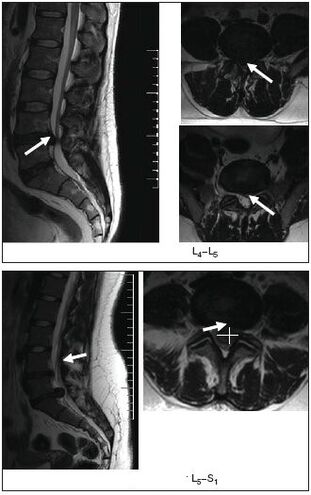
- Radiography, computer or magnetic resonance spinal shot.
MRI is particularly informative
- Ultrasonic overview of the pelvic authorities;
- Gynecological examination;
- If necessary, additional studies are performed: cerebrospinal fluid, blood and urine, sigmoidoscopy, colonoscopy, gastroscopy, etc.
Treatment
Acute low back pain or deterioration of vertebrae or myofascial syndrome
Undifferentiated treatment.Gentle motor regime.In the case of strong pain in the first days, the bed rests, then walk the crutches to unload the spine.The bed should be difficult, and a wooden board should be placed under the mattress.For heat, a wool shawl, electric heating pad and heated sand or salt is recommended.Fats have a beneficial effect: Finalgon, Tiger, Capsin, Diclofenak, etc., as well as mortar and pepper.Ultraviolet radiation in erythemic doses, leeches (taking into account possible contraindications) and irrigation of a painful area with ethyl chloride is recommended.
Electrical procedures have an analgesic effect: transcutaneous electronic, sinusoidal modulated currents, diaglinary electricity, electrophoresis with новокински, etc.Use of reflexology (acupuncture, laser therapy, cauterization) is effective;New leaves Blokada, Massage of pressure trigger points.
Drug therapy includes analgesics, NSAIDs;calming and / or antidepressants;Medications that reduce muscle tension (muscle relaxants).In the case of arterial hypotension, Tizanidine should be prescribed by great caution due to its hypotensive effect.If he suspected for the swelling of spinal roots, diuretics are prescribed.
The main analgesic medications are NSAIDs that patients are often not used uncontrolled when pain intensifies or attempts.It should be noted that the long-term use of NSAIDs and analgesics increases the risk of complications of this type of therapy.There is currently a large selection of NSAIDs.For patients suffering from spine pain, due to availability, efficiency and lower probability of side effects (gastrointestinal bleeding, dyspepsia), preferred "indelective" medications are Diclofenac 100-150 mg / day.Oral, intramuscular, rectively, locally, ibuprofen and ketoprofen oral 200 mg and thematic, and among the "selective" - meloxicam orally 7.5-15 mg / day, Nimesulid oral 200 mg / day.
When treating the NSAID, side effects may occur: nausea, vomiting, loss of appetite, pain in the epigastric region.Possible ulcerogenic effect.In some cases, ulceration and bleeding in the gastrointestinal tract can occur.In addition, headaches, dizziness, drowsiness and allergic reactions (skin rash, etc.).The treatment is contraindicated for ulcerative processes in gastrointestinal tract, pregnancy and breastfeeding.To prevent and reduce dyspeptic symptoms, it is recommended to download the NSAID during or after eating and drinking milk.In addition, taking NSAIDs when pain increases with other drugs to take the patient to treat accompanying diseases, leading, as a long-term treatment of many chronic diseases, as a result, insufficient efficiency of therapy.
Therefore, modern methods of conservative treatment are listed for drugs that have hondro-optotective, hondrastimulating effects and have a better therapeutic effect from the NSAID.On the drugs of Teraflex-Avance fully meets these requirements, which is an alternative to NSAIDs for mild to moderate pain.One capsule The cure of Teraflex-advances contains 250 mg of glucosamine sulfate, 200 mg of chondroitine sulphate and 100 mg ibuprofen.Chondroitin sulfate and glucosamine participate in bio-tissue biosynthesis, helping prevent the crisping process and encourage tissue regeneration.Ibuprofen has analgesic, anti-inflammatory and antipyretic effects.The mechanism of action occurs due to selective cyclooxygenase blocking (COX types 1 and 2), the main enzyme in the metabolism of the arahidone acid, leading to a reduction in prostagland synthesis.The presence of NSAIDs in drug drugs helps increase the range of movements in the joints and reduce the morning's joint stiffness and spine.It should be noted that, according to R.J.Tallarida et al., The presence of glucosamine and ibuprofen in Theraflex-Inventure provides synergism in terms of the analgesic effect of the latter.In addition, the analgesic effect of a combination of glucosamine / ibuprofen is provided 2.4 times lower doze ibuprofen.
After facilitating the pain, it is rational to switch to the Teraflex drug taking, which contains active ingredients hondroitin and glucosamine.Teraflex is taken 1 capsule 3 times a day.During the first three weeks and 1 capsules 2 times a day.In the next three weeks.
The vast majority of patients who take teraflex perceive a positive dynamic in the form of facilities for pain and reduction in neurological symptoms.The drug was well tolerated by patients, allergic manifestations have not been observed.The use of teraflex for degenerative spine diseases is rational, especially in young patients, both in combination with NSAID and as monotherapy.In combination with NSAID, the analgesic effect occurs 2 times faster, and the need for NSAID therapeutic doses gradually decreases.
In clinical practice for the lesions of peripheral nervous system, including those related to spinal osteochondrose, B vitamins, which have a neurotropic effect, are used widely.The method is traditionally used alternately applying vitamins B1, B6 and B12, 1-2 mL each.intramuscularly with daily modification.The course of treatment is 2-4 weeks.Disadvantages of this method include the use of small doses of drugs, which reduces the efficiency of treatment and the need for frequent injections.
Towing therapy is used for discogenous radiculopathy: towing (including under water) in a neurological hospital.For Miophascia Minda, after local treatment (newly blockage, ethyl chloride irrigation, anesthetical fats), on the muscles is inflicted with hot compression for several minutes.
Chronic lumbar pain from vulnerable or myogeneous origin
In the case of drives, it is recommended:
- carrying a rigid corset like a band "mass";
- avoiding sudden movements and bending, limiting physical activities;
- Physical therapy for muscle corset formation and restores muscle mobility;
- massage;
- Novokaine blockade;
- reflexology;
- Physiotherapy: Ultrasound, laser therapy, heat therapy;
- Intramuscular vitamin therapy (B1, B6, B12), multivitamins with mineral supplements;
- For paroxysmal pain, carbamazepine is prescribed.
Drug-free treatments
Despite the availability of the efficient asset of conservative treatment, the existence of dozens of techniques, some patients require surgical treatment.
Indications for surgical treatment are divided into relatives and absolute.The absolute indication for surgical treatment is the development of caudal syndrome, the presence of a blinded hernal interverter, heavy syndrome about radicular pain that does not reduce the treatment.Radiomiemeeloishemia development also requires urgent surgical intervention, however, indications for surgery in such cases, first due to the formation of irretraint changes in the roots, and other, because in most cases, the process within approximately 6 months.The same regression periods have been observed with the delay of the operation.
Relative indications include the failure of conservative treatment and repetitive ischid.Conservative therapy must not exceed 3 months for a duration.and last for at least 6 weeks.It is assumed that surgical approach in cases of acute radical syndrome and the failure of conservative treatment is justified in the first 3 months.After the beginning of pain to prevent chronic pathological changes in the root.The relative indication are cases of extremely severe pain syndrome, when the pain component is replaced by increasing the neurological deficit.
Among physiotherapy procedures, electrophoresis with proteolithic enzyme Caripazim is currently used.
It is known that therapeutic physical training and massage are component parts of a complex treatment of patients with spine lesions.Therapeutic gymnastics has objectives of general body strengthening, increasing efficiency, improving the coordination of movement and increasing fitness.In this case, special exercises aim to restore certain motor functions.